Researchers have achieved another step in a process which may eventually end up with massively powerful computer chip that virtually assemble themselves using the unique properties of DNA
Nathan Tommer
30.8.09


Materials of The Future
Carbon nanotubes and Buckyballs. Architecture on a molecular scale. Endless possibilities.
Nathan Tommer
Nathan Tommer
29.8.09
Lighting Design Inspiration
Arty sunflowers look good and provide power, too
By Paul Ridden
17:38 August 24, 2009 PDT

The Electric Garden comes to life by night using power captured during the day
A boring and unattractive loading area at the rear of a retail development in Austin, Texas is now hidden from view by a collection of 15 huge blue sunflowers, the petals of which collect energy from the sun to power the artwork's LED lighting and generate funds to help towards costs. Whether driving past or walking through the Electric Garden, onlookers will be treated to an awe-inspiring panorama where art meets functionality.
Commuters on Austin's I-35 are in for a pleasant surprise as they pass loading bays at the rear of some retail outlets on the edge of the Mueller Development. An array of northbound-facing large blue metal flowers have recently grown along a footpath behind the complex in an attempt to divert attention away from the busy loading docks and give onlookers pause for thought.
The 15 sunflowers spend the day soaking up the sun using the blue crystalline photovoltaic solar collector panels which sit on welded steel frames and stems. These eye-catching giants also have stamens containing LEDs which bring the installation to life when the sun goes down.
By day, they provide a shaded canopy for cyclists and pedestrians as well as fodder for some interesting conversations. By night, the LEDs illuminate the walkway beneath thanks to special transparent gel-filled areas in the paneling which allow light to flow downwards.
The panels on the petals of the sunflowers use the collected solar energy to power the LEDs but also to help pay for the operating and maintenance costs of the Garden. The excess 15Kw or so of power collected is fed into the grid which generates a credit from the utility company.
The landscaped icon for sustainable development in energy-conscious Austin, which was officially opened on July 30th, also benefits from genuine trees and shrubs and is the work of artists Mags Harries and Lajos Héder.
Eric Collins
Sunlight Transport System
Inhabitat
April 26, 2005

When I first saw discovered this amazing technology, I instantly wondered why no one has come up with a sunlight transport device before. The technology has been around for awhile, and the idea is so fabulous, you would think we would all have these in our homes by now. Swedish company Parans has developed a system of rooftop solar panels that collect sunlight and then transport it via fiber optic cables to illuminate light-deprived rooms inside a house. The light emitting luminaries, which hang from the ceiling like lamps, give off a mixture of parallel light beams and ambient light, which changes as the sunlight outside changes, resembling the dappling of sunlight through trees. Hence the name “Bjork” which is Swedish for Birch tree (No it doesn’t mean Icelandic pop star). The idea is that by bringing outdoor natural light inside a house, you will be able to re-establish a connection with the outside environment, even in the absence of windows or skylights. This sounds like a great idea for New Yorkers, with all the tiny lightless apartments out there. I want one! My one window faces a brick wall. NYC Developers take note.
Eric Collins
Smarter touch surfaces with new pressure sensitive technology
By Darren Quick 
01:43 August 28, 2009 PDT
A sheet of plastic that has been imprinted with thin lines of conductive metal (Images: Porter Gifford)
Resistance touch technology, which generally relies on the use of a stylus or similar instrument, typically detects touch by measuring changes in electrical resistance. But it can only detect one touch at a time. Touch screen using capacitance technology can detect multiple inputs, but can’t detect pressure. Now researchers at New York University (NYU) are looking to get the best of both worlds with a new type of touch-sensitive pad that responds precisely to pressure and can detect multiple inputs at once.
In an attempt to make a pressure-sensitive touch pad to replace the humble computer mouse researchers Ilya Rosenberg and Ken Perlin printed thin sheets of plastic with a pattern of electrically conductive metal lines. A special program is used to design the pattern, which is tailored for the device’s intended usage. The sheet is then covered with an even coat of semi-conductive, pressure sensitive ink.
Eric Layton
Hi-Res LED Pendant Lamp


A bit of inspiration. Beauty in form. Light 4 is an exploratory exercise in trying to understand the iconic nature of objects through their form. Christian Harrup wanted the design to be unique, functional, and memorable. The main structure of this pendant lamp is made of injection moulded polycarbonate and uses high resolution LED’s or linear fluorescents concealed behind a polycarbonate lens. Simple and totally feasible. The shape lends well to a fashion studio thanks to the inherent “hanger” form.
Erik Roth
New LED tech promises more flexible displays
A new LED display process could change the way you watch TV, monitor your health, and gaze out of windows.
Developed by a team of international researchers, the new process creates tiny, ultrathin inorganic light-emitting diodes (LEDs) that shine brighter and last longer than conventional LEDs.

Stretchable micro-LED display, consisting of an interconnected mesh of printed micro LEDs bonded to a rubber substrate.
(Credit: Photo by D. Stevenson and C. Conway, Beckman Institute, University of Illinois)John Rogers, professor of Materials Science and Engineering at the University of Illinois, teamed up with experts at Northwestern University, the Institute of High Performance Computing in Singapore, and Tsinghua University in Beijing to create the new process, as described in a news story published Thursday by the University of Illinois and in the journal Science.

Micro_LED display printed on a thin sheet of plastic, wrapped around a finger.
(Credit: Photo by D. Stevenson and C. Conway, Beckman Institute, University of Illinois)Inorganic LEDs are bright and long-lasting, but they're costly, thick, and difficult to manufacture. Organic LEDs are cheaper and easier to make, thinner, and can be applied to flexible surfaces. The new process combines the best of both worlds.
"Our goal is to marry some of the advantages of inorganic LED technology with the scalability, ease of processing and resolution of organic LEDs," said Rogers. "By printing large arrays of ultrathin, ultrasmall inorganic LEDs and interconnecting them using thin-film processing, we can create general lighting and high-resolution display systems that otherwise could not be built with the conventional ways that inorganic LEDs are made, manipulated, and assembled."
The technology could pave the way for TV screens that you roll up and brake light indicators that fit the contour of your car.
One especially promising use for flexible LED sheets lies in the medical field. "Wrapping a stretchable sheet of tiny LEDs around the human body offers interesting opportunities in biomedicine and biotechnology," said Rogers, "including applications in health monitoring, diagnostics, and imaging."
Eric Layton
CRISTAL
Now we'll never have to leave the couch again! CRISTAL (Control of Remotely Interfaced Systems using Touch-based Actions in Living spaces) is a extreme simple user interface for controlling multimedia devices and home automation systems. Erik Roth
Airport travellers get a robot chauffeur
Driverless, battery-powered pod-cars will soon zip passengers around part of London's Heathrow Airport. The manufacturers of the Ultra personal rapid transit (PRT) system say it is the world's first public transport to balance the convenience of a taxi with the efficiency of a bus or light rail – albeit only for business passengers arriving at the world's third busiest airport.
Personalised rapid transit has been an elusive dream of engineers and city planners. Since the mid 1970s, many schemes have been proposed at sites around the world, and a PRT-like system has been built at Morgantown in West Virginia. But Ultra is the first PRT system to give passengers control over their destination.
Ultra has been in the works since 2005, when BAA – the company that runs Heathrow – ordered a pilot project from Advanced Transport Systems (ATS) of Bristol, UK. Four years later, Ultra is undergoing final tests before its opening to the general public, planned for later this year.
The Heathrow Ultra system will initially carry passengers between the business car park and terminal 5. Each pod-car holds up to four passengers and can travel at speeds of up to 40 kilometres per hour on 4.3 kilometres of dedicated roadway, stopping at any of three stations. The journey takes around 3 minutes, non-stop, with wait times of no more than a minute for the next available car. A central computer system monitors demand and controls traffic.
Jed Davis
Soap bubbles to take the drag out of future cars

Soap bubbles filled with helium are helping to improve the fuel efficiency of future cars.
The 3-millimetre bubbles swirl around cars in a wind tunnel. Engineers at automotive research consultants Mira in Nuneaton, UK, use 12 cameras to track the bubbles, and so capture air flows in unprecedented detail (see video, above).
The helium in the bubbles gives them neutral buoyancy: left to their own devices they will neither rise or fall in the air, so any up or down movement can be attributed to air flow around the car.
"There aren't any tools in use today that can give such insight into what's going on in the fluid around a vehicle," aerodynamics specialist Angus Lock, who is leading development of the system, told New Scientist.
Low drag
Consumers are beginning to consider fuel economy and carbon emissions when choosing a new car, says Lock, and so aerodynamics has become much more important to car manufacturers. Cutting a vehicle's air resistance is usually a cheaper way of improving those stats than reworking an entire engine or drivetrain.
For example, although the Honda Prius's hybrid engine helps boost its mileage, so does the car's shape, which creates much less drag than other cars in its class.
The bubble technique is not completely new. It has long been used to see how air moves around a structure: for example, it was used to test models of NASA's space shuttle. But Mira's camera system gives extra insight by capturing the precise movement of individual bubbles in 3D for later analysis and exploration.
Jed Davis
13.5.09
IND on News 9
This spring semester 2009, the Advanced ID studio and Intermediate ID studio classes participated in a sponsored design project for Pride mobility, a manufacturer of home health care devices. The goal of the project was to develop an innovative wheel chair or adaptive device for Bryan Anderson, who lost both of his legs and his left hand serving in Iraq, to pursue his sporting activities. The final projects were featured on News 9 on May 12, 2009.
15.4.09
Jun 30 2008 Cardboard Bicycles Could Be Coming Soon


Remember the kid that built that wooden bike awhile ago? That thing was sweet and made from trees. And so is this one. Phil Bridge is a 21-year old Industrial Design student that developed a cardboard bicycle. The idea is to make bikes so cheap that nobody will be put off by the thought of buying a bike as a means of personal transportation.
A typical round town bike can cost several hundred pounds. That's a large investment for people who aren't sure whether they will use it. The idea of cardboard is to completely devalue the bike.
Phil's current prototype can hold up to 168-pounds (I'm out), costs $6 to manufacture (frame only, it uses a standard chain mechanism and wheels) and will cost about $24. Allegedly it's even rainproof. It is not, however, fireproof. So be sure to park it inside if you live near a volcano.
A typical round town bike can cost several hundred pounds. That's a large investment for people who aren't sure whether they will use it. The idea of cardboard is to completely devalue the bike.
Phil's current prototype can hold up to 168-pounds (I'm out), costs $6 to manufacture (frame only, it uses a standard chain mechanism and wheels) and will cost about $24. Allegedly it's even rainproof. It is not, however, fireproof. So be sure to park it inside if you live near a volcano.
Ian S.
Apr 23 2008 Exhaust Jack Takes The Work Out Of Jacking

So you got a flat tire, what do you do? Call AAA for help? Make out with your passenger? Cry and punch the steering wheel? Or do you get out there and change the damn thing? You know, changing a tire really wouldn't be that bad if the jacks that come with cars weren't the biggest pieces of shit ever made. Well thankfully, now there's an easier way. Introducing the Exhaust Air Jack ($130). You just throw the orange bag under the car's lift point, attach the hose to your exhaust pipe, and presto, you burnt your hands because you forgot to let the pipe cool before touching it. Not sure if inhaling the bag afterward makes you talk funny like helium, but my guess is no, unless that's how dead people sound. Ian S.
2.4.09
Key to my Memory
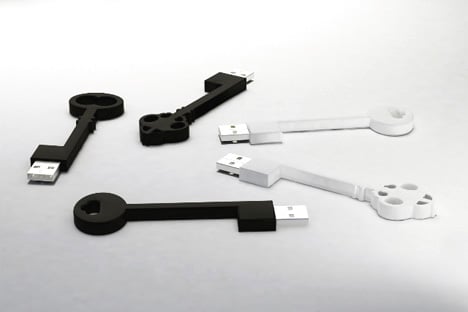
Let’s rewind a bit here and see what I found on the YD pages with regards to USB Stick designs. Some rectangular blobs with no aesthetic appeal whatsoever! Sheesh! A far cry from the sorry Humping Dog or Star Wars Mimobots, the radical USB’s featured on YD should include elegant alternatives like the Clé. Crafted to look like a Victorian era key, the ceramic bodied stick holds either 2GB or 4GB and would look pretty fashionable with your comp.




Subscribe to:
Posts (Atom)