20.3.12

2011 Invention Awards: A Portable Motorized Body Board


Kymera Motorized Body Board
John B. Carnett / Popular Science
The lightweight Kymera Body Board is Jason Woods's solution for a timeless problem (for lucky people): how to have fun at the lake without the hassle of lugging a boat around. The latest version of his motorized body board hits speeds of 25 mph


Posted by: Tom Clark


The PrintBrush


Weighing in at less than a pound, Alex Breton's PrintBrush easily fits in a laptop bag and prints on any flat surface, from wood to fabric to plastic. Alex worked on the project for 11 years, but a version with a bonus built-in camera comes out early next year.


Posted by: Tom Clark

2011 Invention Awards: A Landing Pad For Skiers


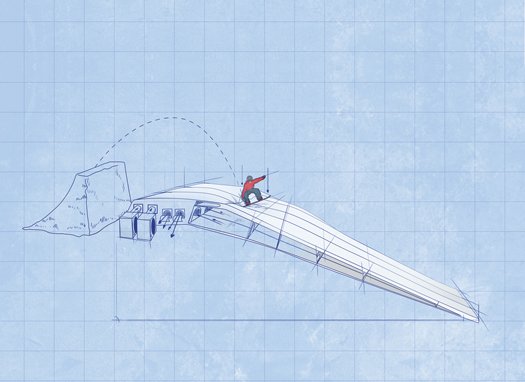
Big Air Stephen Slen [left] and Aaron Coret used their professional snowboarder friends as testers for the landing pad Christopher Morris/Redux Pictures
Six years ago, Aaron Coret, a 20-year-old engineering student at the University of British Columbia and an aspiring pro snowboarder, launched from a 50-foot jump at Whistler Blackcomb. “I remember coming off the lip of the jump and dropping my shoulder too hard. Right then I knew that I had lost control,” he says. “The second I touched down, I lost feeling in my entire body. I slid 60 feet to the end of the landing and stared up at the sky, wondering what my life is going to be like now that everything had changed.”
Paralyzed from the neck down after crushing two vertebrae, Coret resolved to increase the safety of the sport he loved. For his final project in an engineering course, he teamed with fellow student and snowboarder Stephen Slen to create a safe landing pad for ski and snowboard tricks. Working from the back of a sail-manufacturing shop, they created a 15-by-20-by-5-foot vinyl-and-nylon landing pad that contained two inflatable chambers. The upper chamber was sealed, while the four-foot-high lower chamber had valves that released a controlled amount of air on impact. Unlike most landing pads, which give so much that they envelop the athlete, the prototype remained firm enough to land on and ride off of, but it had enough give to reduce the risk of injury.

How It Works: Landing Pad: When a snowboarder hits the pad’s firm vinyl surface, the lower chamber releases a small amount of air through vents on the sides, ensuring a soft, upright landing without enveloping the rider Blanddesigns.co.ukTo test the invention, Coret and Slen went to the top of the Blackcomb glacier. Still completely unsure if the pad was fit to ride, Slen took a deep breath, sailed off a jump, landed on the pad—and slid down it perfectly. By the end of the year the inventors patented their design, formed a company (Katal Innovations, named for a unit of catalytic activity), and began looking for someone who knew how to build large inflatables. They settled on a company that makes custom bouncy castles.
But the new models didn’t have the amount of give that made the first version safe and rideable. “We had to pull out the old prototype and have our friends jump on it while we analyzed why it was working,” Slen says. It turned out that the pad didn’t dump air the way they had thought. In their field tests, the prototype’s valves had released some air upon inflation, so when a rider jumped on it there was immediately “some cushioning movement,” Coret explains. That slight, unintentional deflation was crucial to the design. To replicate it, the inventors used blowers and vents in the new version to continuously add and release air.
Within a year after Coret and Slen had finished their new models, Canadian officials called the pair to a meeting to ask them to use the Katal pad in the opening ceremony of the Vancouver Winter Olympics. It was a triumphant moment, and in the past year Katal pads have been demoed in Alberta, California and Colorado. “We had it on the mountain for five months, and there was big buzz surrounding it,” says Bryan Rooney, the manager of racing, terrain parks and special events on Vail Mountain, “X Games gold medalists and Olympians were lining up. It is a different animal than other airbags.”
Name:Kstal Landing PadInventors: Aaron Coret and Stephen SlenTime: 6 yearsCost: Undisclosed


Posted by: Tom Clark

3D Street Art - New World Record


3D Street art is amazing type of art that uses the perspective of a 2D plane (usually a street) to make it appear as something else in 3D. It boggles you mind how you can trick your brain simply be using perspectives.

Last week, 3D Joe and Max set a new Guinness World Record by created the largest and longest 3D street painting ever. And it is quite impressive.


posted by: Rob Alek

GROVE’S FELT + BAMBOO IPAD CASE


I see a lot of iPad products, but not a lot like these. Grove’s 3rd generation iPad case is simply gorgeous. Hand-crafted in their Portland workshop, this hard bamboo CNC-milled case has coated with three coats of a natural citrus oil and wax blend and an ultra-suede lining. But the icing on the cake is the felt or leather cover.

Read more at Design Milk: http://design-milk.com/groves-felt-bamboo-ipad-case/#ixzz1pfnrKn8Q

Pricey, but really looks great.

posted by: Rob Alek

Quatro chair


Let's re-invent the wheel.


posted by: Rob Alek

18.3.12

Sinks by Gore Design Co.


“purveyors of fine concrete”

By Gore Design Co.
Chad Rice


Chopping Board Experience Gets Better‏


By Weng Hao-Gin & Ke Shiang-Yin

Chad Rice

World's Smallest Race Car Sets Record for Fastest Nanoscale 3D Printing


"The focal point of the laser beam is guided through the resin by movable mirrors and leaves behind a polymerized line of solid polymer, just a few hundred nanometers wide. This high resolution enables the creation of intricately structured sculptures as tiny as a grain of sand."
http://www.youtube.com/watch?v=5y0j191H0kY&feature=player_embedded


By a team at the Vienna University of Technology

Chad Rice

13.3.12

Measurement Device


The Smart Finger is a measurement device concept, uses the signals relayed between the two finger points to calculate the measurement. It can measure length, breadth, and volume in a very intuitive way through simple button operations. The measured distance is displayed through LED.

Posted by Adam Ott

Research Projects


The Stanford/Berkeley Testbed of Autonomous Rotorcraft for Multi-Agent Control (STARMAC) is a multi-vehicle testbed used to demonstrate new concepts in multi-agent control on a real-world platform. STARMAC consists of six quadrotor vehicles that are equipped with sufficient sensing and computing power to enable completely autonomous operation, from low level tasks (e.g. waypoint and trajectory following) to high-level optimal control strategies (e.g. information theoretic cooperative search and rescue).


Posted by Adam Ott

Flying Humvee


Plucky Carter Aviation Technologies has flown its proof-of-concept Personal Air Vehicle (PAV), which incorporates the slowed-rotor/compound (SR/C) technology that AAI has licensed for use in VTOL unmanned aircraft - and DARPA's Transformer (TX) flying Humvee.

Posted By Adam Ott

Bicycle Design Contest


The winners of the 16th annualInternational Bicycle Design Competition (IBDC) were announced at the Taipei Cycle Show last week. From over 800 total entries and 20 finalists, Taiwanese designer Larry Chen took the Gold award this year for his Velocity electric bike design. The pedal assist city bike features a “power core” consisting of a battery, motor, and control unit that slides into the vertical section of the frame from the top. The bike can be used as an e-bike with the power core inserted or as a standard bike with it removed (saving a lot of weight). You can read more about the Velocity, and see several photos of the prototype, at Cycling Satin Cesena.

Posted By Adam Ott.

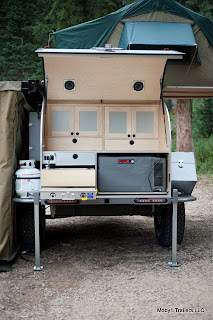
Moby1 Camping Trailers


Posted by: Jared Brown